

The Chinese government takes AI seriously. Its AI+ strategy, which aims to integrate AI across industry, consumer markets, and public services, has support from the highest levels of government. President Xi Jinping gave the keynote at the World Artificial Intelligence Conference in Shanghai on July 17, 2026, calling AI “a new engine of world economic growth”. China has a competitive ecosystem of AI companies whose models are mere months behind the frontier.1 It also has much of the world’s AI talent, with 41% working in China vs. 34% in the US, and is second only to the US in AI compute capacity, with 15% to the US’s 75% as of March 2025 (more recent chip-owner estimates, from a different dataset, put China’s share at 9%).
But is the Chinese government2 mobilizing to compete directly with US AI companies on frontier training runs, as we might expect if its leaders thought AGI3 was likely in the next few years? One revealing approach to answering this question is to look at China’s compute infrastructure.
Different expectations for AI imply different compute priorities
Drawing on Raghav Akula and Oliver Guest’s framing4, let’s define two broad perspectives on AI and their policy implications:
Adoption-focused beliefs. AI is a transformative but fundamentally normal technology, and its impact will depend on overcoming real-world bottlenecks. The government’s role is to help break through these bottlenecks while addressing the negative externalities that change inevitably brings.
If the Chinese government has adoption-focused beliefs, it would likely prioritize cost-effective AI models tailored to specific contexts and would favor inference compute over training compute. It would promote the diffusion of AI tools through the wider economy, potentially with more distributed compute, particularly for low-latency industrial applications. It may support a diverse landscape of providers to foster competition, experimentation, and innovation. Its international efforts would likely focus on AI diffusion and innovation.
Frontier-focused beliefs. AGI is achievable in the next few years and could give any actor that possesses it an overwhelming economic or military advantage. So the gap between the AI frontier and widely accessible AI systems is critically important and justifies exceptional investment to close it.
If the Chinese government has frontier-focused beliefs, it would likely deprioritize narrow AI applications in favor of models that can adapt to the widest range of contexts. It would centralize compute to enable large-scale training runs, like those of US frontier AI companies, and would favor training and research compute over inference compute. It may encourage the AI ecosystem to consolidate into fewer, better-resourced training and research pipelines. Its international efforts would likely focus on security coordination between AI superpowers.
The Chinese government is made up of many people5 whose beliefs about AI differ somewhat. Policymakers may also give partial credence to both sets of beliefs (for example, broadly adoption-focused but open-minded about AGI). The result could be a mixed or hedged strategy, such as focusing mainly on AI adoption while building the infrastructure to compete on the AI frontier. That said, the Chinese Communist Party (CCP) has a top-down leadership structure and powerful levers over industrial strategy, so we can usefully treat the Chinese government as a broadly coherent and unified actor on AI.
Timelines to AGI also determine which policies make sense today. A government that expects AGI after 2050 will pursue different policies than one that thinks it could arrive next year. On longer timelines, diffusing existing AI through the economy would take priority even for policymakers who expect AGI eventually. Compute spent on training is compute not spent on serving users now. If AGI is decades away, a lead of a few months is worth little: Frontier capabilities reach fast followers quickly, and the lead doesn’t compound. However, on short timelines, a lead could compound (for example, through recursive self-improvement) and become decisive, justifying exceptional costs to reach the frontier.
Could a frontier-focused Chinese government decide not to race to the frontier the way leading US companies do? Potentially, yes, if it believed that AGI would require a paradigm other than transformer-based large language models (LLMs). But more compute for AI R&D would still help it investigate other paradigms. If a new paradigm does emerge, US companies are likely well placed to adopt it, given their extensive resources. A frontier-focused China would want its leading companies to be similarly well placed. And earlier access to frontier LLMs would boost AI R&D.6 A government that takes near-term AGI seriously would therefore prioritize timely access to training compute, even if it also pursues a different paradigm.
Might China bet on scaling reinforcement learning (RL) rather than ever-bigger pretraining runs? DeepSeek R1 showed that large capability gains can come from more RL on top of an existing base model. RL training is closer to inference and easier to spread across multiple sites. However, RL gains depend on the size of the base model, and US companies are also scaling RL with far more compute. So a frontier-focused Chinese government would be incentivized to concentrate as much compute as possible, even if it relied heavily on RL training.
Total compute alone cannot distinguish the two strategies
Both perspectives imply that it is good to build more AI data centers and chips. Total compute infrastructure7 can therefore show that a government takes AI seriously without telling us whether it is focused on near-term AGI.
Just by looking at total data center buildout, it seems clear that China is, at minimum, focused on adoption8: In March 2025, it had nearly three times as much compute as the European Union, which ranked third behind the US and China.
China also seems to be building data centers faster than it can fill them with AI chips: In 2024, the racking rate (the share of racks with chips in them) of data centers in China’s national computing hubs averaged 62%, with rates as low as 30-40% in some western provinces. In North America, by contrast, data centers had a leasing vacancy rate of 1% in 2024 and 2025. Much of China’s buildout may have been driven by local government speculation rather than top-down efforts, but the low racking rates suggest that China is building AI capacity well ahead of current or near-term demand.
To distinguish the two strategies, we need to look at what the compute can be used for. One of the clearest differences is the priority given to closing the capability gap between leading Chinese and US models.9 A useful test is whether China is building the capacity to train frontier AI.
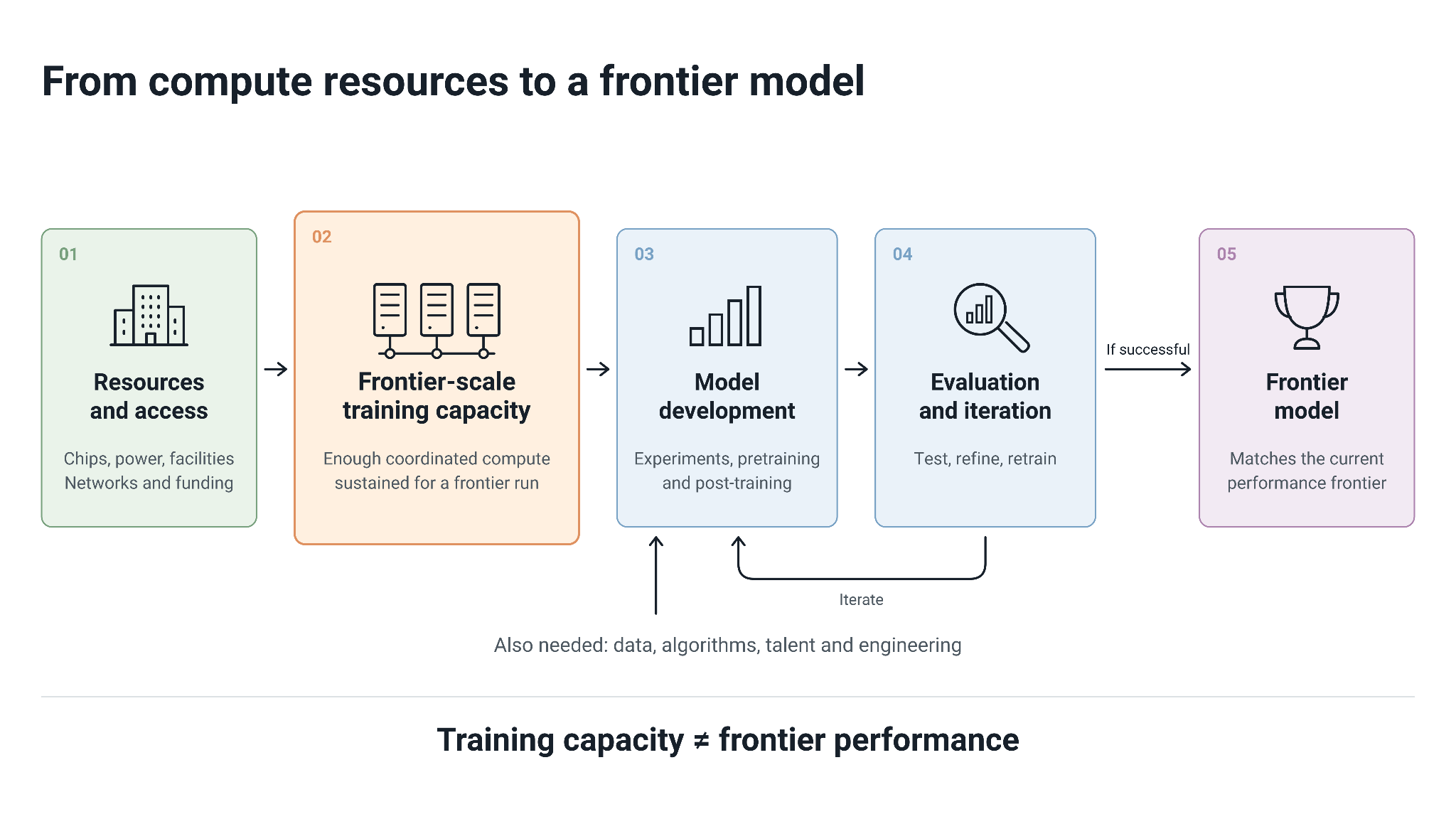
The current AI frontier is hard to pin down. It’s not clear whether OpenAI or Anthropic has the most capable model, particularly as their best models are likely internal. In hindsight, however, we know where the frontier was in February 2026: Anthropic’s first Mythos model. A previous Substrate post by Hamish Low estimates that Anthropic spent about 5e26 FLOP to train Mythos, equivalent to roughly 330,000 H100s running for three months at 20% effective utilization. Let’s take this as the benchmark for a Mythos-scale training run.10 Could any Chinese entity have supported such a run in February 2026, assuming it had Anthropic’s algorithms?11
Epoch AI estimates that China had around 1.8 million H100e (H100-equivalents) in the fourth quarter of 2025, just over half of Epoch AI’s estimate for Microsoft’s total compute. A Mythos-scale training run would have taken about a fifth of China’s total compute for three months.12 That’s a sizable chunk, but feasible for a truly frontier-focused actor.
Compute capacity for a Mythos-scale training run would not, by itself, distinguish an adoption-focused strategy from a frontier-focused one. Concentrating compute could also make sense for efficient inference: There are economies of scale, and for many use cases, distance has negligible impact on latency. But a lack of frontier training capacity, if it were feasible to build, would be evidence against a near-term AGI push. China’s total chip ownership does suggest that it had the hardware for a Mythos-scale run at the time.
What options did a Chinese entity have to reach the Mythos-scale training threshold in February 2026?
Own, rent, or commandeer a single data center in China that meets the threshold.
Own, rent, or commandeer several data centers in China that together meet the threshold, and connect them with enough bandwidth to act as a single training cluster.
Own, rent, or commandeer many AI chip clusters in China and connect them over the internet, with enough chips and bandwidth for a distributed training run that meets the threshold.
Access compute outside China equivalent to (1), (2), or (3).
Training over the internet (3) is unattractive in China’s compute-constrained environment. It may be technically possible at frontier scale, but with current techniques it is considerably less efficient than centralized training. To reduce bandwidth requirements, approaches such as DiLoCo train model replicas independently before combining their updates, which introduces a divergence penalty that grows with the number of replicas. Going from one site to eight requires 1.5x as much training compute for the same performance, and a naive extrapolation to 10,000 sites suggests a 6x penalty. Internet-based training might make sense if China had a large surplus of AI chips, or if an international agreement limited centralized training. But neither condition currently applies.
Overseas compute (4) is a less dependable route because access could be cut off. The Chinese government has emphasized secure, controllable supply chains and domestic innovation. Overseas capacity could be part of a transitional strategy, but we should expect China to develop domestic capacity for reliable access to the frontier. Stealing model weights presents a similar problem: A successful theft might temporarily bring a Chinese entity to the frontier, but keeping up would require repeated thefts. These would presumably become harder once the first was discovered, as US companies improved security and the US government responded.
That leaves a single large site (1) and several closely connected sites (2) as the most plausible and sustainable domestic routes to the AI frontier.
Could China support a Mythos-scale training run?
What would implementing (1) or (2) look like? Could we observe them easily? For (1), we would expect to see at least one data center in China that could plausibly house 330,000 H100e. Epoch AI maintains a database of the world’s largest data centers. The largest Chinese entry, VNET Bayin Ulanqab, was operational in February 2026, with an estimated 123,000 H100e. This is around a third of the Mythos-scale threshold, well short even with generous allowances for estimation error and higher utilization than at US companies.13
How confident can we be that Epoch AI identified the largest data centers in China? While its dataset is not comprehensive,14 and currently covers the US better than China, we should expect the largest data centers to be the easiest to identify, as they are the most power-hungry and give off the most heat, which also makes them hard to conceal.15 And Chinese companies have made no secret of their plans to build much larger AI data centers than VNET Bayin Ulanqab.16 All this suggests that the largest Chinese AI data centers operating at the time were publicly known, so (1) appears both observable and unavailable as of February 2026.
Connected sites (2) are harder to observe. The five Chinese sites that Epoch AI tracks held only about 210,000 H100e between them in February 2026. But Epoch AI covers only a small share of China’s compute, so there were probably enough large data centers in China to host a Mythos-scale training run, if coordinated and linked with sufficiently high-bandwidth cabling. China’s Eastern Data, Western Compute project covers coordination and connectivity between data centers. A State Council meeting in September 2026 called for more data center connectivity and for using market mechanisms to better coordinate compute supply and demand. Open-source information may show whether such links existed, as might observing the physical infrastructure in and around these data centers.
Even if China had the compute infrastructure for (2) in February 2026, a single Chinese entity would have had to coordinate all these data centers. China does have systems that could in principle play this role, such as the National Integrated Computing Power Network and the Ministry of Industry and Information Technology’s overlapping network of compute interconnection nodes. But these systems are designed to match idle compute with users rather than coordinate usage, and as of mid-2026, no single body appears to have the authority to commandeer compute across multiple sites. Furthermore, (2) is strictly harder than (1): It adds long-range connections between data centers, which introduce further points of failure, and often involves coordinating heterogeneous mixes of AI chips.
Released Chinese models provide another clue. Moonshot AI’s Kimi K2.5, released in January 2026, has 32 billion active parameters and was trained on around 30 trillion tokens. These figures give an estimate of 5.8e24 FLOP of training compute, or about 3,800 H100s running for three months at 20% effective utilization,17 nearly 90 times less than a Mythos-scale run would need. The most capable publicly available Chinese model at the time doesn’t reveal the size of the largest Chinese training run, and says even less about the largest run then possible in China. But it does indicate the rough size of the largest models that Chinese companies were incentivized to produce and release on the open market: fast-following models that are relatively cheap to serve, rather than frontier AI.
The Chinese government has also left frontier-relevant compute on the table. After the US allowed exports of NVIDIA’s H200 chips to China in December 2025, Chinese customs blocked their import in January 2026. Later that month, the Chinese government approved purchases of over 400,000 H200s by Alibaba, ByteDance, and Tencent, but with conditions still undecided, reportedly including how many domestic chips the companies must also buy. US license reviews then held up shipments into the spring, after which Beijing withheld import approval. The first deliveries, of around 10,000 each to ByteDance and Tencent, arrived only in August, and most of the chips must stay outside the mainland, for example in Hong Kong, which lacks the power needed to run them. In November, Reuters reported that around 600,000 H200s were piling up in Hong Kong while Beijing withheld approval for large-scale imports, and NVIDIA—following the ongoing controversy related to Jensen Huang and Megaspeed—said that it had stopped shipping its licensed AI chips to China. An H200 has roughly the same compute as an H100, so the 400,000 approved chips alone would likely have been enough for a Mythos-scale training run. If the Chinese government were focused on reaching the AI frontier, it would be unlikely to sacrifice short-term frontier training capability for trade leverage or progress toward long-term chip self-reliance.
Under the benchmark assumptions above, the largest known Chinese site fell short of a Mythos-scale run in February 2026, and we have seen no evidence of a coordinated run across multiple sites. The most capable released Chinese models at the time used much less training compute than even the existing infrastructure could have supported, and the Chinese government has kept most approved H200s out of the mainland. All this is tentative evidence against a near-term Chinese AGI push. Mapping the largest data centers and their connections would allow a more confident assessment.
Looking ahead, we can estimate the compute needed for a frontier training run by extrapolating the current trend of 5x annual growth in training compute. We can then compare this with the likely capacity of planned Chinese data centers to see whether China will soon be able to do (1). Both Z.ai and DeepSeek have 1 GW data centers in the works: Z.ai has reportedly completed one that uses only Chinese chips, though only part of it is operating, and DeepSeek reportedly plans one that would start coming online in late 2027 or early 2028. (Z.ai’s site is probably far from full: Ten days after reporting its completion, Bloomberg wrote that a 1 GW data center “would be far larger than anything now operational from a Chinese company”.) The extrapolated trend suggests that such a facility is unlikely to enable a frontier training run by then.18
What can we learn from Eastern Data, Western Compute?
The location of Chinese compute offers another clue. An adoption-focused strategy would put more emphasis on inference to serve customers. Inference compute is more tolerant of distribution, as it gains less from being concentrated in one place.19 A frontier-focused strategy would put more emphasis on concentrated training clusters, which are the most effective way to coordinate enough compute for a single training run. Given the US’s 5x to 10x compute advantage,20 China would need to devote a larger share of its compute to training than the US does to achieve the same frontier performance. So if China were frontier-focused, we would expect heavy concentration of compute.21
The Chinese government has provided a roadmap for distributing AI-relevant compute across China: the Eastern Data, Western Compute project, launched in 2022. The plan aims to shift compute from the coast, where the main customers are, to hubs in western China, where power is cheaper and land is more plentiful. In practice, this hasn’t happened: Most compute remains near major cities and industrial centers, such as Beijing, Shanghai, and the Greater Bay Area. As ChinaTalk puts it, “the overall map doesn’t suggest China has moved compute to the west”.
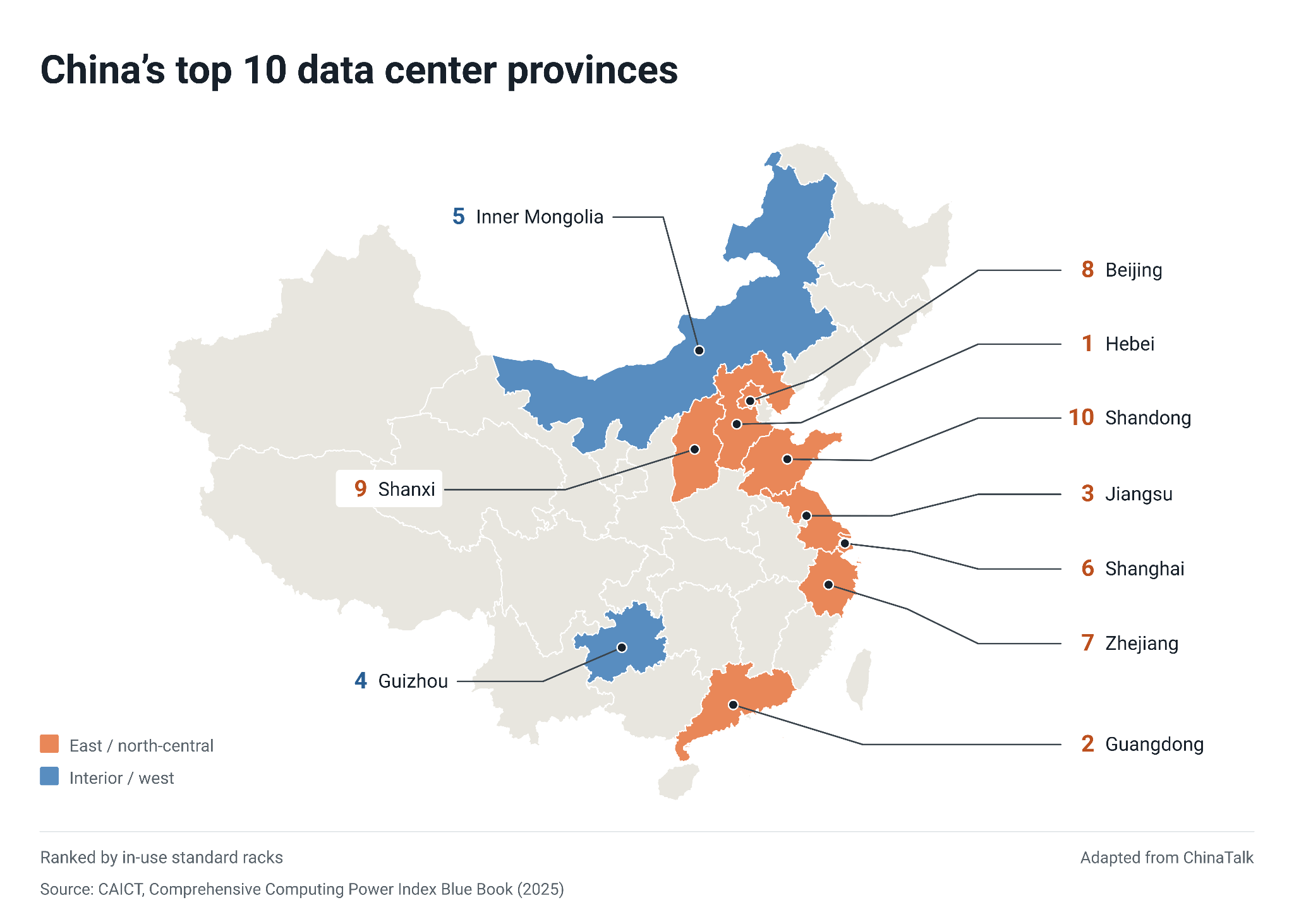
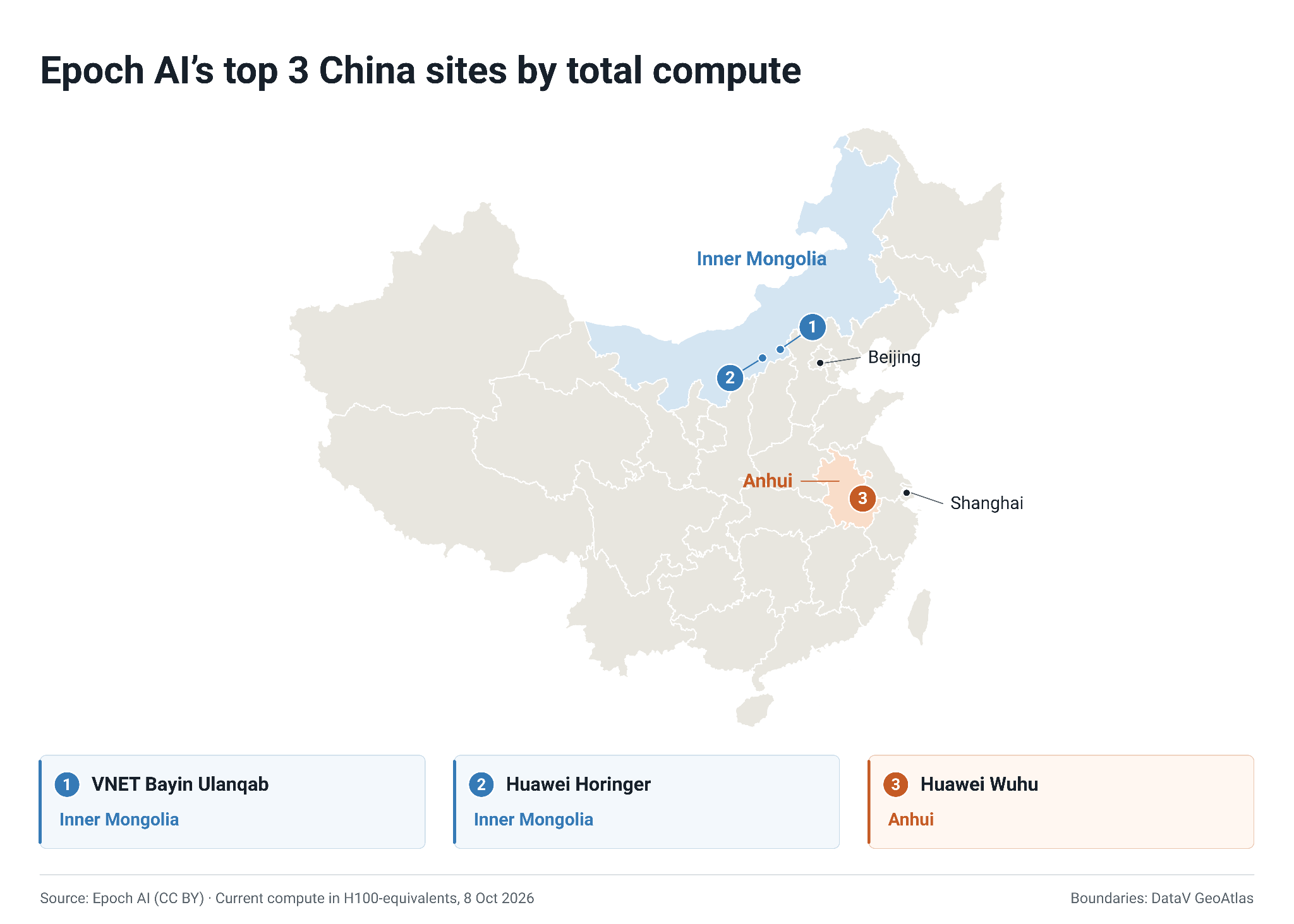
Epoch AI’s list of China’s biggest data centers is also revealing. Three of the five sites are in Inner Mongolia, and a fourth is in Hebei, all relatively close to Beijing, with the fifth in Anhui, near Shanghai. The sizes and distribution of China’s AI data centers fit an adoption-focused strategy much better than a frontier-focused one.
If China’s strategy shifted toward the frontier, we would expect larger, more concentrated data centers in western China rather than around commercial, financial, and industrial hubs. Other indications would include a system to coordinate compute for training runs across users, dedicated inter-data-center cabling of sufficiently high bandwidth,22 and explicit government announcements prioritizing training infrastructure over inference. Apart from the gigawatt-scale sites planned in Ulanqab, Inner Mongolia, which is one of the project’s western hubs, we haven’t seen clear signs of such a shift, which suggests that China is not strongly focused on the AI frontier.
Conclusion
China’s visible compute infrastructure appears better suited to spreading AI through the economy than to a concentrated push for near-term AGI. Combined with the decision to restrict purchases of H200s, this suggests that through mid-2026, the Chinese government was not acting as if AGI were a few years away, and was prioritizing AI diffusion over pushing the frontier.
However, uncertainties over capacity, utilization, and connections between sites limit what the infrastructure can tell us about policymakers’ beliefs. Better mapping of the largest sites, and of who can coordinate their compute, would enable a firmer conclusion. Infrastructure also takes time to build, so a change in policy would precede any visible sign of it: If the Chinese government had changed its strategy recently, we couldn’t tell from the infrastructure alone. Plans for future buildout are the next place to look for clues to current government thinking on the AI frontier. A cursory glance at public announcements of gigawatt-scale data centers in China suggests that these alone would not put China anywhere close to the AI data center frontier.
For example, as of publication, Kimi K3.1 Pro and DeepSeek V4.1 Flash 1017 are the leading open-weight models on the Artificial Analysis Intelligence Index.
This piece focuses on the Chinese government, as Chinese AI companies are unlikely to have the resources or incentives to reach the AI frontier on their own (I define the AI frontier as the most capable AI models at the broadest range of tasks, regardless of inference cost). Leading Chinese AI companies have far fewer resources than their US counterparts. DeepSeek recently raised funding at a valuation of about $92 billion, while Anthropic was valued at around $1.5 trillion in its November 2026 initial public offering. China has around a tenth as much AI-relevant compute as the US, which may still be enough to compete at the frontier if concentrated in a few frontier-focused companies. But investors are unlikely to fund a Chinese company enough to match Anthropic or OpenAI in model size when those companies’ frontier models are already on the market.
AI that is approximately as capable as competent humans at almost all economically relevant cognitive tasks. Functionally: an AI that can serve as a remote worker roughly as effectively as a human competent in the relevant domain, requiring no more supervision or accommodation than a human worker.
I have collapsed their focuses on AI adoption and global diffusion into a single focus on global adoption.
The CCP has over 100 million members, and the Chinese government employed around 7 million civil servants as of 2015. However, the leadership is much smaller: The Central Committee, the CCP’s top body between party congresses, has around 200 full members.
See Anthropic’s description of how its models have already increased its researchers’ output: When AI builds itself.
AI compute infrastructure is the physical capital needed to train and serve models: AI accelerators, their high-bandwidth memory, and networking equipment, plus the buildings, power systems, cooling, and wider network connections that support them.
This buildout, read alongside China’s AI+ strategy, suggests that the Chinese government does believe AI is at least as transformative as the Industrial Revolution.
We can focus on comparing Chinese and US models, as no other country is anywhere close to the frontier.
This is just the compute capacity for a Mythos-scale run: Training a model as capable as Mythos with the same compute is far from guaranteed, as indicated by the capability gap between leading Grok models and leading Claude and GPT models.
Chinese entities could also make algorithmic improvements beyond those of US frontier AI companies, or use their chips more efficiently and so need fewer. But any such discount is unlikely to be steep enough to change the broad framework sketched here. Chinese companies are incentivized to use chips more efficiently than US companies because they have less compute, but US companies can also use their compute advantage for more R&D, which could put them ahead on efficiency. And significant algorithmic advances generally diffuse freely between the two ecosystems.
These are highly uncertain estimates, both of the compute available in China and of the chips’ effective utilization rate. But in aggregate, China very likely had enough compute for such a run.
If the VNET Bayin Ulanqab site achieved over 50% effective utilization, or was used by a single entity for about eight months rather than three, it could plausibly host a Mythos-scale training run. But this seems unlikely, and the frontier has moved on since February 2026.
Epoch AI’s estimate for global coverage of chips through its frontier AI data center dataset is 44%, and 17% in China specifically.
See this analysis of covert AI projects by the AI Futures Project to learn more about the engineering challenges of concealment.
VNET’s 2025 ESG report describes its Hyperscale 2.0 strategy, launched in 2025, including gigawatt-scale campuses.
5.8 × 10²⁴ FLOP ÷ (989 × 10¹² FLOP/s per H100 × 20% utilization × 90 days × 86,400 seconds/day) ≈ 3,770 H100 SXM GPUs for 90 days.
Increasing the Mythos-scale estimate of 330,000 H100e by 5x a year from February 2026 to the end of 2027 gives about 6.3 million H100e. Scaling Epoch AI’s estimate for VNET Bayin Ulanqab (123,000 H100e at 221 MW) up to 1 GW gives about 557,000 H100e. Though highly uncertain, this is less than a tenth of the extrapolated requirement.
Concentrating inference compute could still be useful because of economies of scale.
Given US chip export restrictions and NVIDIA’s lead over Chinese AI chip designers in output and quality, this gap is likely to widen through at least 2030, even though Epoch AI expects Huawei to narrow NVIDIA’s lead in production.
This alone would not distinguish an adoption-focused strategy from a frontier-focused one.
See this description of the connectivity needed between data centers.
