

On November 8, NVIDIA opened an investigation into its co-founder and CEO, Jensen Huang, after he admitted to an affair with a senior executive at Megaspeed, whom the US government suspects of being a Chinese spy. Megaspeed is a nominally Singaporean company with deep ties to China that has rented out advanced NVIDIA chips to Chinese companies, and may also have smuggled some into China.
That is, the CEO of one of the world’s most important companies, who spent years insisting that there’s no evidence of any AI chip smuggling, while lobbying to sell more AI chips to China, has admitted to a relationship with an alleged Chinese spy who was also an executive at one of the company’s biggest customers in Southeast Asia. That customer bought at least $4.6 billion worth of NVIDIA servers to rent out to Alibaba and other Chinese companies, and is also suspected of smuggling AI chips into China. And when that executive and alleged spy was detained in Singapore, NVIDIA’s top lawyer contacted the Commerce Department officials investigating the customer to ask what was going on, after which the Justice Department took over the investigation.
Megaspeed is an interesting case not only because of its connections with Jensen Huang (but also, of course, because of that). It’s interesting because it shows the two main ways Chinese companies get restricted AI chips:
Remote access. Megaspeed bought NVIDIA servers, installed them in data centers in Southeast Asia, and rented them to Alibaba and other Chinese companies. This is generally legal so long as neither the chip owner nor its ultimate parent company is headquartered in China. (That said, it looks almost as if Megaspeed were a Chinese company, or as if Alibaba owned the chips, given that Alibaba reportedly lent Megaspeed money and took its Malaysian business as collateral, and given also that Megaspeed’s executives and owners have close ties to China. When New York Times reporters visited Megaspeed’s Singapore office in 2025, they found only two employees there, and were told that most of its directors were based in China.)
Smuggling. Here the evidence is thinner, but US officials suspect that some of Megaspeed’s chips ended up in China. When in late 2025 NVIDIA audited Megaspeed, at the US government’s request, it couldn’t find about 50,000 of the chips. And two of the eight data center operators that NVIDIA told US officials it had visited said they didn’t have Megaspeed’s servers. Citing people familiar with a related Chinese company, The Information has reported that Megaspeed bought NVIDIA chips and “either rented them out remotely from data centers in Southeast Asia to Chinese customers, or physically shipped them into China”. (Megaspeed has categorically denied smuggling chips.)
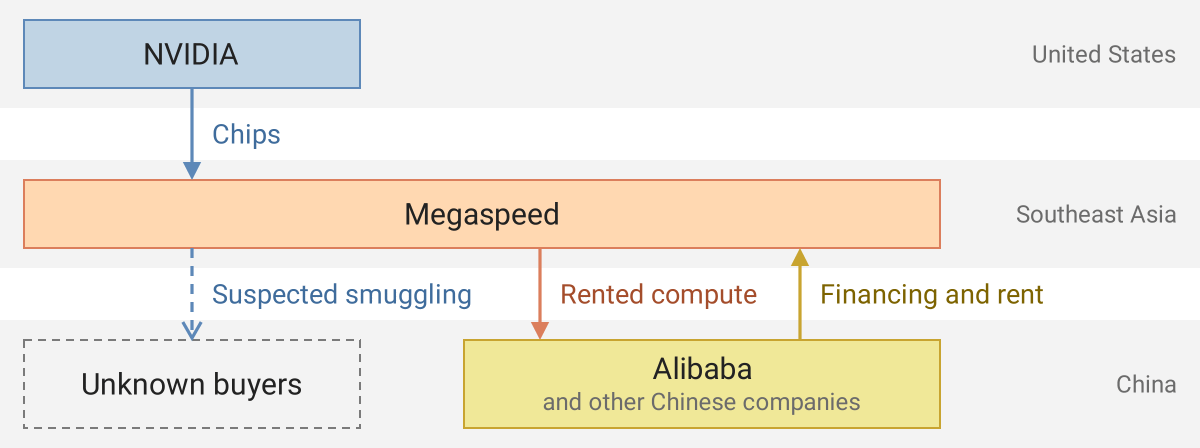
Megaspeed has reportedly imported at least 136,000 NVIDIA chips from 2023 through November 2025, worth at least $4.6 billion. In its audit, NVIDIA found about 86,000 of them and failed to find the remaining 50,000. I estimate that only about 40,000 NVIDIA H200s have entered mainland China since the US government allowed those sales in December 2025. So Megaspeed bought over 3x as many NVIDIA chips as all of mainland China has received under the new licenses, and may have smuggled about as many.1 (NVIDIA later said that, after visiting additional Megaspeed warehouses, it had identified “substantially” all of the chips, though it hasn’t said how many it found there; Jensen Huang has said NVIDIA “counted every one”.)
Even 50,000 smuggled chips would be only a small part of the total. According to two people who know her, the alleged spy, Alice Huang (no relation to Jensen Huang), helped arrange at least $7.5 billion worth of NVIDIA chip shipments through Chinese companies, which moved about 240,000 banned NVIDIA chips into China. (It’s unclear how much of this overlaps with Megaspeed’s purchases.)
Megaspeed is one of many alleged cases of NVIDIA chips being smuggled to China. In the Super Micro case, in which a co-founder of the company was charged in March 2026 with smuggling AI servers to China, a Bangkok firm called OBON reportedly received at least about $2.5 billion worth of servers. Those would have required over 100 megawatts of data center capacity, and Thailand has only a few hundred megawatts of total capacity. In Singapore, the CEO of Aperia, one of NVIDIA’s first official Cloud Partners in Southeast Asia, is accused of running a smuggling operation (he has pleaded not guilty). And according to Chinese financing filings, Moonshot AI, the developer of the Kimi models, rents banned NVIDIA servers in China that belong to a drone distributor, which bought them from a subsidiary of an online liquor seller. (Moonshot AI disputes the filings.) In most of these cases, a little-known company orders far more AI chips than it has a clear business use for, but gets them anyway.
NVIDIA’s decision to sell to Megaspeed, and how quickly Megaspeed became an NVIDIA Cloud Partner, are puzzling.2 Megaspeed received the Cloud Partner designation—which gives a company a public stamp of approval and preferred access to NVIDIA chips—four days after being set up in November 2023. Demand for NVIDIA chips is so high that NVIDIA chooses who gets to buy them and how many. Larry Ellison, Oracle’s co-founder and chairman, once described a dinner with Jensen Huang as “me and Elon begging Jensen for GPUs”. That dynamic gives NVIDIA leverage over its customers. According to The Information, cloud provider executives say that fear of angering NVIDIA is “always at the back of their minds”, and that some of their customers don’t want their own use of AMD chips advertised. OpenAI has reportedly avoided taking a public position on AI chip exports to China so as not to alienate NVIDIA, on whose chips it relies. (NVIDIA says it allocates fairly and that customers “can choose whatever solution is best for them”.) So why do hundreds of thousands of NVIDIA chips end up with little-known Southeast Asian companies, while US companies are clamoring for more compute?
How much compute China gets through smuggling and remote access
Together, smuggling and remote access probably account for almost half of the compute China has access to, more than its own AI chip industry has produced.
The best data I know of on the scale of smuggling comes from Epoch AI and is built from customs records through June 2026.3 The dataset implies that about 970,000 H100-equivalents (H100e)4 of restricted NVIDIA chips had arrived in China by the end of 2025, and about 1.2 million through June 2026. (This is my reading of the dataset’s breakdown by chip type.5) About half of the 1.2 million arrived in just nine months, from October 2024 to June 2025.6
970,000 H100e is about 6% of all the AI compute delivered worldwide from 2022 through 2025, and about 8% of what NVIDIA shipped in 2024 and 2025. But it’s about half of all the AI compute added in China (including chips made there) over those four years.7
It’s possible that smuggling has fallen since mid-2025 because of crackdowns in Malaysia and Taiwan as well as measures taken by NVIDIA (more on those below), though I’m pretty uncertain about this. Epoch AI’s trade data implies that about 230,000 H100e of restricted NVIDIA chips arrived in China in the first half of 2026, down from about 420,000 in the first half of 2025 (though up from about 180,000 in the second half of 2025). The markup on smuggled NVIDIA chips in China seems to have risen from about 1.5x the US price in mid-2025 to nearly 5x in October 2026, which is what you’d expect if supply had shrunk.8 (The Moonshot AI servers were valued at about 4.5x the US price in August 2026.) And an analysis of trade data by Epoch AI suggests that smuggling through Malaysia fell in July 2025 after its government cracked down.
Meanwhile, Chinese companies appear to be renting more compute from cloud companies with data centers in Southeast Asia. According to the Financial Times, the tighter screening that NVIDIA introduced in 2026 “forced more Chinese tech groups to pursue leasing deals with overseas cloud providers”. The Institute for Progress (IFP) estimates that Chinese companies will be able to use about 1 million H100e in data centers outside China by the end of 2026. NVIDIA has reportedly lobbied especially hard against rules that would restrict remote access.
IFP estimates that China will have access to about 4.6 million H100e by the end of 2026. Of that, about 1.7 million comes from chips made in China, about 1 million is rented in data centers outside China, about 1 million was smuggled in (the trade data above suggests more, about 1.2 million), and about 850,000 was imported legally. If those estimates are right, smuggling and remote access together make up about 45% of China’s compute (about half of that from smuggling and half from remote access). That is more than everything China’s own AI chip industry has ever produced.9
What NVIDIA says and what it has done
Asked about smuggling in October 2026, NVIDIA said:
That “US prosecutors allege less than one half of one percent of NVIDIA products have been diverted”
That the diversion found so far is “a drop in the bucket compared to the ocean of domestic compute China already has”
The first claim is roughly right as far as it goes, but it only counts chips in cases that prosecutors have charged. That number should be treated as a floor, since US authorities have likely caught only a small share of smuggling cases.10 By my reading of the Epoch AI trade data, the figure is closer to 8% of the compute NVIDIA shipped in 2024 and 2025, or 11 to 16 times as much as the 0.5% NVIDIA offers.11
The second claim I don’t think holds up. When making it, NVIDIA pointed to the roughly 2 million AI chips that Chinese chip manufacturers are expected to produce in 2026. But those chips are much worse than NVIDIA’s. By my estimate, 2 million of them amount to something like 850,000 H100e, less than the roughly 1.2 million H100e of restricted NVIDIA chips estimated to have reached China by June 2026.12 In the same Epoch AI trade data, Huawei and Cambricon, two of China’s leading AI chip designers, shipped about 1 million H100e in total through June 2026, so smuggled NVIDIA chips likely outweigh everything those two have delivered since 2024.
NVIDIA has done more to stop smuggling in 2026:
After the Super Micro indictment in March, it removed half of the Asian firms on its list of pre-approved buyers.
By early November 2026, it had told cloud providers that at least 51% of their services must go to non-Chinese customers.
It now requires new Cloud Partners in Southeast Asia to enroll in its chip location tracking system.
The first of these measures seems to have helped, at least to some degree. According to the Financial Times, the shorter list “meant fewer advanced NVIDIA chips entered China via smuggling”.
But one might fairly ask why NVIDIA didn’t do this in 2024 or 2025, when there were already many credible reports of smuggling and NVIDIA was saying there was no evidence of it. And it’s hard to tell how well these new measures work. The 51% rule was reportedly communicated verbally and only applies to new contracts. The location system doesn’t share any location data with NVIDIA or the US government by default, and NVIDIA hasn’t said whether existing partners like Megaspeed have to join. And all these actions are voluntary: NVIDIA could quietly reverse them whenever it wants, or apply them halfheartedly.
All that said, none of this means the export controls have failed. People often ask me how big a deal AI chip smuggling is and whether it means the export controls aren’t working. What I usually tell them is that the export controls are working, but that they’re not as effective as they could be. According to IFP, the top five US AI companies have on average about 16 times as much compute as the top five Chinese ones, and China produces only around 1-2% as much compute domestically each year as the US and its allies do.
So thanks to the export controls, the US has far more compute than China does. But because of smuggling and remote access, Chinese companies get far more compute than they otherwise would—something like 80% more, if IFP’s estimates are correct.13
How did we end up here?
Here is a more detailed timeline:
In October 2022, the US government restricts the export of advanced AI chips to China. The ban covered NVIDIA’s A100 chip as well as its then-upcoming H100. The rule caught NVIDIA by surprise, but the company quickly designed new versions (the A800 and the H800) that just skirted the performance thresholds so it could keep selling to China. When the US government closed that gap in October 2023, NVIDIA released the further pared-down H20 for the Chinese market.
In 2023 and 2024, Megaspeed appears and starts buying billions of dollars’ worth of NVIDIA chips. It had been the Singapore arm of 7Road, a Chinese gaming company with state-backed investors, until it was split off and relaunched as Megaspeed in March 2023. Corporate records show Alice Huang as Megaspeed’s managing director from March to November 2023, and its owner at the time as Huang Le Limited, a British Virgin Islands entity bearing her Chinese name. On LinkedIn, she has reportedly described herself as Megaspeed’s CEO. In November 2023, Huang Le Limited sold Megaspeed to a Singapore company owned by Megaspeed’s current CEO, and four days later Megaspeed became an NVIDIA Cloud Partner. In December 2023, Alice Huang met with Jensen Huang and a few colleagues at a restaurant in Singapore, and in June 2024, the two were photographed at a bar in Taipei.
In 2024 and 2025, reports of large-scale AI chip smuggling into China mount. For example, in August 2024, the New York Times and The Information each reported that large quantities of banned NVIDIA chips were being smuggled into China, with brokers using shell companies and staged data centers in Southeast Asia to move single orders worth more than $100 million. Jensen Huang denied that any smuggling was happening, telling Bloomberg in May 2025: “There’s no evidence of any AI chip diversion. These are massive systems … you’re not going to be putting that in your pocket or your backpack anytime soon.” That same month, NVIDIA accused Anthropic of telling “tall tales” about chip smuggling. In June 2025, Tim Fist and I published our second report on AI chip smuggling for the Center for a New American Security, summarizing many of these cases and suggesting ways of reducing smuggling. In July, the Financial Times reported that at least $1 billion worth of banned NVIDIA chips had reached China in three months.
From 2023 to 2025, NVIDIA tries to discredit critics at Washington think tanks. In 2023, according to The Information, NVIDIA tried to use its influence, including funding, to sideline Greg Allen, a supporter of export controls at the Center for Strategic and International Studies. (NVIDIA said at the time that it had never taken issue with his work.) In 2025, according to Sam Hammond of the Foundation for American Innovation, he posted that NVIDIA was “arming China’s military” and NVIDIA emailed his boss.
In September 2024, a Commerce Department official visits a Megaspeed data center in Malaysia. The New York Times would later report that US officials “were concerned that NVIDIA technology on site was still in boxes”. In early 2025, Alice Huang and Kang Wei, her business partner, reportedly pitched investors on a data center project, saying they had “no problem securing GPUs” and citing Alibaba as a client. A year after the visit, US officials reportedly still had no conclusive evidence that Megaspeed had smuggled chips to China.
In 2025, after heavy lobbying by Jensen Huang and NVIDIA, the US government loosens the AI chip controls on China. NVIDIA originally proposed selling the B30A, a version of its latest-generation Blackwell chips, but after internal discussions, in December 2025, the US government allowed it to sell H200s. The H200 is from the earlier Hopper generation but still a substantial upgrade over what was previously available in China. Back in July, at a press conference in Beijing, Jensen Huang had said: “I hope to get more advanced chips into China than the H20. … Export control[s] are things that are outside of our control and they can be quite disruptive to our business. It is our job only to inform the governments of the nature and the unintended consequences of the policies that they make.”
In summer 2025, Singapore authorities detain Alice Huang. According to the New York Times, they barred her from leaving the country and questioned her as part of an investigation into false import declarations, though the investigation into her was later closed for lack of evidence. NVIDIA’s general counsel then reportedly called Under Secretary for Industry and Security Jeffrey Kessler, who oversees export controls at the Commerce Department, to ask whether his agency was involved in the detention.
In October 2025, the Megaspeed case becomes public through a New York Times report. The report said that Commerce was investigating whether Megaspeed, which had bought “nearly $2 billion” worth of NVIDIA products, was helping Chinese companies evade US export controls. Most of these purchases went through Aivres, the US subsidiary of a Chinese server builder called Inspur, which is on the US Entity List for acquiring US technology in support of China’s military. NVIDIA said there was no evidence that its chips had been smuggled into China, and that Megaspeed had not raised any red flags. NVIDIA also said that Megaspeed was owned and operated by a company headquartered outside China, with no Chinese shareholders, and that it was “running a small commercial cloud”. At the time, Singapore police said that “investigations are ongoing into Megaspeed for suspected breaches of our domestic laws”. (Megaspeed says this investigation ended in 2026 with no action against it, but according to the New York Times, Singapore authorities have said they are still investigating the company.)
In late 2025, the Commerce Department pauses its investigation into Megaspeed. A few months earlier, NVIDIA’s general counsel had emailed agents working on the case “seeking information about the inquiry” and said their boss (Kessler) had given him permission to reach out. The agents declined to meet with him. Commerce officials then disclosed the episode to the Justice Department, which asked Commerce to pause its work, reportedly to avoid compromising the case. (The Justice Department’s own criminal investigation reportedly continues. According to Bloomberg, Commerce “has not made any progress since then, despite the agency having enough evidence to move forward”.)
In late 2025, at the US government’s request, NVIDIA audits Megaspeed and fails to account for all the chips. NVIDIA promised in December 2025 to carry out follow-up visits, but has since declined to say whether it has carried them out. NVIDIA said at the time that it had asked the US government whether it needed to cut off Megaspeed and was told no. (NVIDIA now says it had already blocked sales to Megaspeed in June 2025.) In November 2025, a month after the Commerce investigation became public, Megaspeed imported at least 17,544 more of NVIDIA’s most advanced chips, worth about $787 million, according to trade records analyzed by Bloomberg.
In March 2026, the US government charges Super Micro co-founder Wally Liaw and two others in the largest AI chip smuggling case to date. Prosecutors alleged that the three had sold a middleman company in Southeast Asia at least about $2.5 billion worth of AI servers since 2024, most of which were smuggled to China. (Liaw has pleaded not guilty. One of the other two, Ting-Wei “Willy” Sun, reportedly pleaded guilty in October 2026.) Bloomberg later reported that some of the servers allegedly went to Alibaba (which Alibaba denies).
In spring 2026, Secretary of State Marco Rubio oversees the writing of a classified memo alleging that Jensen Huang is intimately involved with Alice Huang and that she is a Chinese spy. According to later reports, US intelligence had concluded that China’s Ministry of State Security had recruited her.
On October 1, 2026, Bloomberg reports that US officials believe China has smuggled in the equivalent of at least 115,000 restricted NVIDIA chips. (This should be viewed as a lower bound; the trade data discussed above implies several times more.) NVIDIA acknowledged that smuggling happens but, as mentioned above, called it “a drop in the bucket”.
On October 29, 2026, the New York Times reports that US intelligence agencies have concluded that Alice Huang is a Chinese intelligence asset who developed a close relationship with Jensen Huang. Jensen Huang said in response that his interactions with Alice Huang “have been related to Megaspeed, and it was all completely normal and not unusual”. An NVIDIA spokesperson likewise said that the interactions “are not unusual or unexpected” and that NVIDIA is “confident that if the US government believes that any person is a threat to American industry, it would let us know”.
On November 5, 2026, the Republican chairmen of three House committees ask Jensen Huang to appear at a closed-door briefing.14 The next day, the New York Times reported that Alice Huang had been recruited by the Ministry of State Security “to learn more about American AI chips and potentially influence the company to push for its most advanced chips to be made available to China”. In response, NVIDIA said that its customers do not ask it to press the US government to change its policies on chip sales to China.
On November 7, 2026, the New York Times reports that the Commerce Department has granted H200 licenses to apparent Chinese shell companies. At least two of the licensed firms had no physical presence at their listed addresses and appeared to be linked to companies on the Entity List, and at least two others had ties to Chinese military suppliers. Commerce appears to have approved “roughly two dozen Chinese firms to buy or handle NVIDIA’s H200 chips”.
On November 8, 2026, Jensen Huang acknowledges the relationship with the alleged Chinese spy, and NVIDIA’s board opens an investigation. In a message to employees, he wrote: “I was unfaithful to my wife. My actions hurt her and our children. There is no excuse for what I did. I am deeply sorry. … I love our country and our company. I am committed to protecting NVIDIA and supporting America’s national security. I am proud and grateful to be an American.” The board said it had “no reason to believe that either national security or NVIDIA secrets were compromised”. NVIDIA said that outside counsel will conduct the investigation, and that Jensen Huang will continue to lead the company in the meantime.
What’s next?
By now nearly everyone is investigating someone. NVIDIA’s board is investigating Jensen Huang, the Justice Department and Singapore are investigating Megaspeed, the Commerce Department (which got there first) was investigating Megaspeed but was asked to pause, the FBI is investigating who knows what, and Democrats in Congress are calling for an investigation too.
First, US policymakers will have questions for NVIDIA and Jensen Huang, for example, if they appear at the closed-door briefing on November 18. They might ask him:
Where are the 50,000 chips that NVIDIA’s audit failed to find, and did the company carry out the follow-up visits it promised in December 2025?
Has NVIDIA leadership had any role in approving sales to Megaspeed or other companies suspected of smuggling?
Why did NVIDIA’s general counsel ask about the Commerce Department’s investigation into Megaspeed after Alice Huang was detained in Singapore?
Why didn’t NVIDIA take stronger measures against AI chip smuggling in 2024 or 2025?
How did Megaspeed become a Cloud Partner four days after its sale in November 2023?
Did the alleged spy acquire any sensitive information about NVIDIA technology?
Second, NVIDIA’s board has reportedly hired the law firm Wachtell Lipton to lead its investigation, which will be directed by a former acting US attorney. It remains to be seen how impartial and thorough that investigation will be. NVIDIA and Jensen Huang are also facing a shareholder lawsuit, filed on November 9, that alleges that they misled investors about his relationship with Alice Huang and about NVIDIA’s dealings with Megaspeed.
Third, we don’t yet know what will come of the Justice Department’s investigation into Megaspeed, or whether the Commerce Department will resume its investigation, or what the FBI investigation will result in. Nor do we know why the Commerce Department didn’t stop AI chip sales to Megaspeed when it may have known that one of the company’s senior executives was suspected of being a Chinese spy. Commerce staff has reportedly flagged the risk of NVIDIA chips being diverted to China in “dozens” of reports in recent months, but senior officials have not acted on them. According to the Financial Times, the State, Energy, Treasury, and Defense Departments have pushed to add Megaspeed to the Entity List, but the Commerce Department (which chairs the interagency process) has delayed new additions over the past two months.
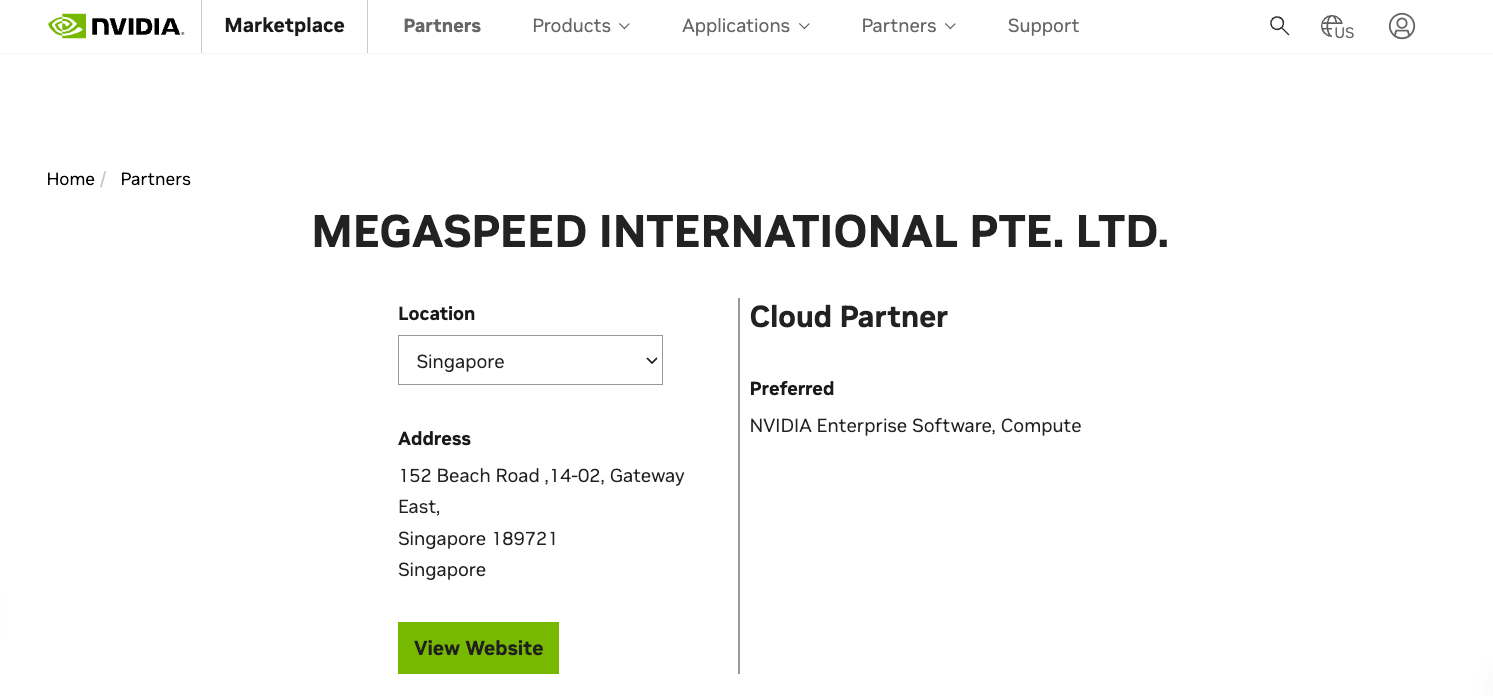
Meanwhile, Megaspeed is reportedly nearing completion of the first phase of a data center in Malaysia, for which it has already secured AI chips. NVIDIA says it put Megaspeed on its block list in June 2025, “prohibiting any further sales or shipments”. But according to Bloomberg, Megaspeed imported about $787 million worth of NVIDIA GB300s in November 2025, and according to the New York Times, Megaspeed and its affiliates kept buying NVIDIA products in 2026, often through intermediaries. As of today, Megaspeed is not on the Entity List, nor has it been removed from NVIDIA’s list of Cloud Partners:
Fourth, all this is happening as Congress and the White House discuss strengthening export controls and enforcement. Congress is negotiating whether to include three export control bills (the AI OVERWATCH Act, the Chip Security Act, and the MATCH Act) in this year’s defense authorization bill. The White House has also reportedly asked Congress for a provision that would require the Commerce Department to write a rule restricting remote access to certain chips.
The Financial Times reported in August 2026 that ByteDance and Tencent had each received about 10,000 H200s, and that a few other Chinese companies could soon get approval for shipments of similar size. In November 2026, Reuters reported that several Chinese companies had each obtained about 10,000 H200s, and that about 600,000 more were stored in Hong Kong as Chinese authorities withheld approval. I assume that four companies have received 10,000 each (though it might be anywhere from two to six). 136,000 divided by 40,000 is 3.4, and 50,000 divided by 40,000 is about 1.3. These quantities refer to chips, not compute. More than half of Megaspeed’s chips are Blackwells, according to Bloomberg, and those are substantially more powerful than the H200.
According to The Information, Alice Huang told colleagues and customers that she could always get supply, mentioning her close relationships inside NVIDIA and with NVIDIA distributors.
Epoch AI also estimated AI chip smuggling in April 2026, concluding that about 660,000 H100e (90% CI: 290,000 to 1.6 million H100e) were smuggled to China through 2025. But as I understand it, the newer trade data is more accurate.
An H100-equivalent is the computing power of one NVIDIA H100, an AI chip released in 2022. Epoch AI’s calculations of H100e differ somewhat from those we typically use at The Substrate, which are based on Total Processing Performance (TPP). For example, a B200 counts as about 2.5 H100e in Epoch AI’s data, and about 2.25 by TPP.
Epoch AI estimates each country’s AI server imports from customs records. For China, it assigns the imports that legal chips can’t account for to “NVIDIA GPUs assumed to reach China through diversion after export controls”, after adjusting for a premium for smuggled chips. I add up China’s figures for the NVIDIA chips that couldn’t legally be sold there (that is, H100s from 2024 on, B200s, and B300s). The estimate is too high if other imports are counted as any of these chips, and too low if banned AI chips reach China undeclared.
About 610,000 of the 1.19 million H100e, that is, 51%, arrived in those three quarters.
The same dataset has 17.4 million H100e arriving in all countries from 2022 to the end of 2025, and 2.0 million H100e arriving in China during that time. NVIDIA shipped about 12.3 million H100e in 2024 and 2025, according to Epoch AI’s AI chip sales data. 970,000 is 5.6%, 48%, and 7.9% of those, respectively. The 2.0 million includes about 650,000 H100e of chips made in China. IFP’s estimates, which I discuss below, imply a smaller share for smuggled chips (about 28% of the compute located in China, that is, excluding remote access), since they run to the end of 2026, use a lower smuggling estimate, and count more legal imports.
The Financial Times reported in July 2025 that NVIDIA B200 racks sold in China at about a 50% premium over US prices. In November 2026, it reported that a B300 rack that costs about $600,000 outside China sold for about $2.8 million in China in October 2026, that is, 4.7x. The markup and the trade data aren’t independent evidence, though, since Epoch AI converts import values into chips using an assumed markup for smuggled chips, which it raises in 2026. Measured in dollars, the restricted NVIDIA chips arriving in China in the first half of 2026 were worth about 23% less than in the first half of 2025, and about 48% more than in the second half.
According to IFP’s estimates, remotely accessed and smuggled compute sum to 2.05 million H100e, which is 45% of 4.6 million, whereas Chinese-made chips account for 1.7 million. With 1.2 million smuggled instead of 1 million, the share is 47%. IFP’s estimates are highly uncertain, with numbers plausibly ranging from 380,000 to 2.9 million H100e for smuggling, and 680,000 to 1.5 million H100e for remote access. Varying only the smuggling estimate moves the combined share between about 36% and 61%.
Under Secretary Jeffrey Kessler told lawmakers in July 2026: “We’re concerned that there are cases that we either haven’t detected, or that we just don’t have the resources to chase down.”
7.9% is about 16 times as much as 0.5% (whereas Epoch AI’s April 2026 estimate of about 660,000 H100e is 5.4% of what NVIDIA shipped, or about 11 times as much as 0.5%). One caveat here is that the two figures aren’t measured in the same way. NVIDIA’s is a share of “NVIDIA products”, while mine is a share of the computing power NVIDIA shipped in 2024 and 2025.
In its report, IFP expects China to make about 2.3 million AI chips domestically in 2026, equal to about 986,000 H100e (or 0.43 H100e per domestic chip). Using that ratio, 2 million chips are about 850,000 H100e, and a less or more performant mixture of chips would give 500,000 to 1.2 million H100e. (Note that this compares one year of Chinese production with everything smuggled since 2024.)
In IFP’s estimates, smuggled and remotely accessed compute totals 2.05 million H100e for China, and compute legally imported and domestically produced in China is 2.55 million H100e. 2.05 divided by 2.55 is 80%.
The chairmen are Brian Mast of the Foreign Affairs Committee (which has jurisdiction over export controls), John Moolenaar of the Select Committee on the Chinese Communist Party (which opened an investigation into NVIDIA’s chip sales to China and Southeast Asia in April 2025), and Rick Crawford of the Permanent Select Committee on Intelligence (which oversees the US intelligence agencies).