

Right now, the US leads over China in AI. Yes there is a lot of nuance to that statement, and yes China does have advantages in areas like energy production and humanoid robotics, but on the whole it’s obvious that the US is in some sense ahead in AI.1
My current best guess is that this is very good2. I think a large US lead over China is better for the world (not just for the US), and that a shrinking US lead would be bad. A large lead gives US companies and the US government more room to test frontier AI systems, make them secure, and avoid panicked decisions. I also think it’s better if frontier AI development happens mostly in a pluralistic, open society with checks and balances. This is one reason why much of my work has focused on understanding and improving US export controls on AI chips and tooling (though, of course, other factors affect the costs and benefits of these controls aside from their effect on the lead). But while I’m confident enough in this to act on it, I’m still overall pretty uncertain and think it would be good to understand these dynamics better.3
So why should someone in, say, Hungary or Brazil care whether the US lead in AI grows or shrinks? The most obvious implication is the relative economic and military power of the US and China, which will, I think, increasingly be determined by AI. But the lead also has consequences that go beyond which great power ends up more economically and militarily powerful. For example, if one country leads in AI over the crucial next few years and decades, it may have outsized influence over the future of humanity. Or the size of the lead, or the rate or direction of change in the lead, may affect the likelihood and outcome of a conflict between the US and China. Or, if the US lead is very small, this could severely constrain its ability to, for example, develop and implement necessary safeguards.
What I mean by “lead”
What do I mean by “lead”, anyway? I don’t think we need a precise definition to make progress here,4 but what I have in mind is roughly a gestalt comprising many different factors: AI model capabilities, the capabilities of entire AI systems (including agent harnesses), compute and other infrastructure, capital and customer bases, and more generally the strength of each country’s broader AI ecosystem.5 In addition to technical capabilities, it matters how technical capability is converted into power, e.g., as measured by AI adoption in industry and government. The actual lead is of course very jagged and any single measure of it is reductive (more on that in a moment), but broadly speaking, the country in the lead will control more, and more capable, AI systems, and will have a military and economic advantage as a result.
Focusing narrowly on the lead does leave out some important details when evaluating policies that affect the lead, namely:
A policy will have many effects, some of which can’t be anticipated, and this is all very messy and complicated. For example, export controls on AI chips and tooling have, beyond their direct effects on the lead, had other effects, like causing friction in US-China relations and incentivizing faster Chinese indigenization of AI chip making.6
I’m focusing on the US and China here, but the size of the lead could have complicated effects on middle powers too. For example, a larger or growing US lead could incentivize middle powers to align themselves with the US, and vice versa.
The overall, global pace of AI progress matters for these dynamics. If you measure the US lead in months, for example, a six-month lead is in some sense much larger in a world where AI progress is extremely fast than in a world where it’s quite slow.
So yes, these things complicate the picture. That said, I think it’s still worth setting them aside for a moment and analyzing the lead in isolation. But that means that, when we evaluate policies, the effect on the lead is by no means the only thing that matters, though it is one thing that matters.
Some distinctions
What question am I asking, exactly? It’s possible to distinguish between a few versions of the question. These distinctions are illustrated in these six stylized plots:
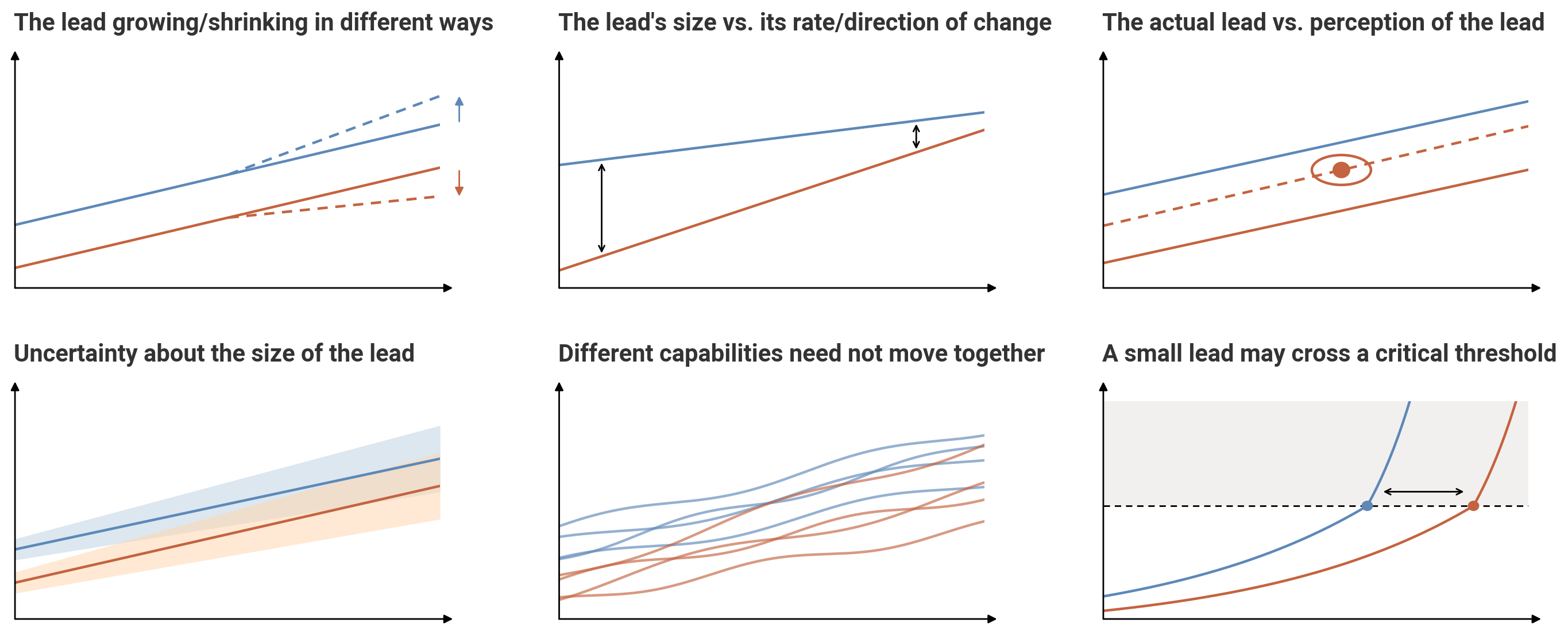
First, the lead can grow or shrink in at least four ways: by speeding or slowing US progress, and/or by speeding or slowing Chinese progress. Although speeding US progress and slowing Chinese progress may have the same effect on the lead (e.g., increasing it by three months), they could have very different effects on the world (speeding up frontier AI progress versus not).
Second, there is a difference between the size of the lead and the rate and direction of change in the lead. For example, even if the lead is large, if it starts shrinking quickly, that could be highly destabilizing and prompt drastic actions by either side. This distinction could also matter for the prospects of any bilateral agreement on AI in particular: the side that’s improving faster may be less inclined to agree to any deal that entrenches the status quo, because it may be in a better position in the future.
Third, systemic bias can make the actual lead and decision-makers’ perception of the lead come apart. During World War II, scientists in America raced to build the atomic bomb partly because they wrongly believed the Germans were much closer to building one than they in fact were.7 Something similar could happen with AI. Another way this distinction could matter is if AI becomes an increasingly important element of military power, because countries might be more likely to go to war if they both think they’re stronger than their rival, and less likely if they both think they’re weaker.
Fourth, there’s uncertainty about the size of the lead. We might be confused about the empirical facts about each side’s capabilities or conceptually confused about what it means to “lead”. Today, it’s pretty clear that the US is, in some holistic sense, ahead. But between individual AI companies, things are much murkier. Is Anthropic in the lead, or is OpenAI, or are they basically tied, or does it not make sense to talk about a “lead” when the gap is so small? It feels very hard to say, and whatever answer you land on seems like it could flip within weeks or months. The same could happen with the US lead over China. If these countries are very uncertain about their rival’s capabilities and are risk-averse, they might act as if the lead is much smaller than it really is.
Fifth, the lead can be jagged. Even a single benchmark flattens differences in model capabilities across subtasks, and the US might, say, end up with better AI models and more compute while China has advantages in energy, manufacturing, and robotics. In that world, even with perfect information about both sides’ capabilities, there might be no meaningful answer to who’s ahead overall without specifying which outcome we care about, and everything gets messier and more ambiguous.
Sixth, there could be a tipping point past which a lead gets permanently locked in.8 This could happen because recursive self-improvement causes runaway progress, because the leader gains a decisive strategic advantage (i.e., a position of superiority that lets an actor take permanent control of the world), or for other reasons we haven’t thought of. If so, even a small lead could be decisive, and so it might matter a lot not just how big the lead is, but also, or maybe most of all, when it is.
What does a lead do?
This section and the next outline research questions that would inform the broader question of what would make a large and/or growing US lead good or bad for the world. In each section, I’ll highlight a few questions I think are most promising9, then briefly list a few additional questions that seem less important or very hard to make progress on.10
How does the size of the lead affect competition, cooperation, and safety?
Would a larger lead make the US and/or Chinese governments less likely to make panicked, rushed decisions? It seems pretty plausible that if, say, the US feels threatened by a China that’s very close in AI progress, it has both less time to think through important decisions and more appetite for risk. Either could lead to worse decisions, in both foreign and domestic policy. And more generally, a world with a very small lead might just be more chaotic, more volatile, and less predictable. Or, conversely, if one side is far behind and fears the other is about to lock in a permanent advantage, it might be more or less likely to take drastic action.
Would a larger lead result in the US directing more resources towards developing AI safely? (And additionally: Would those resources make the AIs more aligned, corrigible, interpretable, honest, robust, and so on?) This is sometimes discussed as paying a “safety tax” or “alignment tax”: as AI continues to improve and the stakes of failure rise, US companies or the US government may take actions to ensure AI is developed safely, actions that could slow progress (e.g., by redirecting compute from AI capabilities research to these safety efforts). A large lead might be necessary for unilateral US slowdowns or safety measures, and a larger lead could allow the US government and companies to pay a larger “safety tax” should they want to, and delay deployments for longer (as happened with Project Glasswing and the subsequent voluntary US framework allowing up to 30 days of pre-release government access), without jeopardizing their lead over China.
I don’t know whether or when those efforts should be seriously scaled up, or when deployments should be seriously delayed, but it seems many AI company employees feel pressure to cut corners on safety, as evidenced by over 1,300 of them signing the Pacing the Frontier letter in July, stating that “each company—and country—is under intense competitive pressure not to unilaterally slow” AI progress.
Would a larger lead make an agreement, or other cooperation on AI, between the US and China more or less likely? And we can ask the reverse: Does a larger lead make a military conflict between great powers more or less likely? The US and China may want to reach an agreement on AI development and use, or at least take steps in that direction. Of course, any such agreement must include strong verification mechanisms, since neither side is likely to trust the other to abide by it. The size of the lead could affect the likelihood of this outcome. For example, a larger lead could make competition over AI less salient overall, leaving both sides more willing to negotiate. Or, conversely, if China is far behind, it may be less willing to tie its hands and lock in an unfavorable status quo.
Additional, less important questions:
Does a larger lead make it easier for the leading companies to coordinate amongst themselves? It could be beneficial if these companies coordinate, for example, to direct more resources towards alignment or interpretability efforts, but it might also be dangerous to have more power concentrated in a few highly coordinated actors. (Note that there are currently barriers to companies coordinating, particularly antitrust law.)
Will a larger lead mean that the gap between the best closed models (e.g., Claude and GPT) and the best open-weight models (e.g., Kimi K3 and DeepSeek) is also larger? And if so, is this a good thing or a bad thing?11 Currently, the best open-weight models are released by Chinese AI companies, while leading American AI companies generally don’t open-source their models. However, this could change, either because American open-weight models improve (for example, if Meta catches up) or because Chinese AI companies stop releasing weights for their best models.
Does a larger lead mean the US is more likely to try to gain and/or succeed in gaining a decisive strategic advantage? I’ll discuss some implications of a possible decisive strategic advantage more later on.
How does a growing or shrinking lead affect stability?
The most obvious effect of a growing lead is that it makes the lead larger. A larger lead may have the effects discussed in the previous section. But beyond those, the fact that a lead is growing, or shrinking, could on its own have effects on the world.12
How does the direction of change in the lead affect incentives to cooperate or fight? This question, I think, is even more relevant to the rate and direction of change in the lead than to its size. For example, if one side is progressing faster than its rival, it may be less inclined to negotiate or cooperate, while the side that’s progressing more slowly may be more inclined to negotiate or cooperate. Similarly, if the leader sees its lead shrinking, it may be incentivized to protect it (cf. the Thucydides Trap, though this concept has been criticized) or to negotiate to preserve the status quo, and vice versa. A lot of these effects seem annoyingly symmetrical, so perhaps they cancel each other out, or perhaps not, depending on each side’s bargaining leverage, beliefs about future progress, and ability to make credible commitments.13
Would a quickly growing or shrinking lead generally increase volatility or panic in a way that leads to worse or riskier decisions? A future in which the size of the lead changes rapidly from year to year, or even month to month, may be more chaotic and less predictable than the counterfactual.
Who should be in the lead?
In addition to the abstract effects of the lead (whether it’s large, or growing), it might also matter who’s actually in the lead. And if you strongly prefer one country to be ahead, that might also mean you want the lead to be larger, since a larger lead lets the preferred country do more with it.
Who is more likely to develop powerful AI safely?
It could matter immensely where very powerful AI14 gets developed first. This probably won’t be a question of whether it’s developed first in the US or in China. Whatever threshold of very powerful AI you have in mind, it seems pretty likely that either the US and China get there at roughly the same time, or the US gets there first, and the question is just how much earlier. Unless the US gains and uses a decisive strategic advantage, a larger lead probably just means China gets there a bit later than it otherwise would, not that China doesn’t get there at all.
If both countries will develop very powerful AI at some point, who cares whether AI will be more aligned, corrigible, interpretable, honest, robust, and so on in one country than in another? Well, I care, for three reasons:
There are path dependencies in AI development, where laggards may copy techniques used by leading developers.
Laggards may benefit from leading developers’ better understanding of AI, and leading developers could share technology and knowledge to control and align it; this effect could be stronger the larger the gap is between the leader and the laggard.
It’s at least theoretically possible that the leading developer could prevent laggards from ever developing very powerful AI by achieving a decisive strategic advantage.
With that in mind, here’s what I’d most like to know about where very powerful AI should ideally be developed.
How do the safety culture and safety capabilities of leading US AI companies compare to those of leading Chinese ones, and how important is this difference? Right now, US AI companies (in particular OpenAI, Anthropic, and Google DeepMind) seem to publish more relevant AI safety research and put more effort and organizational attention into safety than Chinese AI companies do. They also seem able to publicly disagree with their government in ways that would be unthinkable for Chinese companies and the Communist Party. If this difference is real and large, and if it’s still there as very powerful AI is being developed, then it might be better for it to be developed in the US first, and maybe also for the gap between the US and China to be larger.
Would the development of very powerful AI be more transparent in the US than in China, and how would this matter? I think the US public, the media, and the world at large will have a better sense of what happens inside US AI companies and inside the US government than inside Chinese AI companies and inside the Communist Party. There are several reasons for this. First, whistleblowing is more common and better protected in the US, and there may be more people motivated to do so at leading US AI companies. Second, the US has a stronger, more independent press than China does. Third, the US government is less inclined to control information than the Communist Party, which for example famously suppressed details about the origins of COVID-19. If this is right, it would be useful to know how much this difference matters for the successful development of very powerful AI.
Will the US’s stronger checks and balances reduce the risk of coups or of extreme power concentration? Power seems more distributed in the US than in China: in the US, it is somewhat split among the three branches of government, and the US government is influenced and scrutinized by companies, by a mostly independent media, and, of course, by voters.15 In China, by contrast, the Communist Party has centralized control to a much greater extent.
Additional, less important questions:
How do the two countries approach risk? Is China, for example, more risk-averse or more stability-oriented than the US? In 2023, Chinese companies held back chatbot releases as the Communist Party finalized new rules and approved their products. More recently, the US government held back releases from Anthropic and OpenAI for cybersecurity testing. It does seem Chinese AI companies are more eager to deploy AI models quickly, but this could simply be because these models are less capable than the best American models.
Does China have greater state capacity than the US, and if so, does it matter? If AI development moves very quickly, governments may need to make decisions and implement them quickly too. There might also be a broader question here about the relative competence of the two governing systems.
Who is more likely to use powerful AI well?
Suppose future AIs are aligned, and the US government and companies manage to avert global catastrophes and so on. Then AI might give whoever controls it a huge amount of power. It seems plausible that the first country to develop very powerful AI permanently shapes the future of humanity, e.g., because of path dependencies in AIs’ values,16 or because the US, China, and maybe other countries strike some deal that apportions the future, so to speak, according to their relative power. If so, a bigger US lead may give the US more influence over the future. This raises some further questions.
Which country is more likely to distribute the benefits of AI widely, including to those who are not, or were previously not, citizens of that country? It may be better if countries that treat both their own citizens and outsiders well, and that will share the prosperity created by these future AIs more widely and reasonably, have greater influence over the future.
Which country is more likely to lock in some set of values permanently, or in any other way foreclose future debates about norms and values? It would have been bad if the norms and values of ancient Babylon had been locked in permanently, for example, and it could similarly be bad if today’s norms and values are made permanent. Can liberal democracy survive the development of very powerful AI, and if so, can it help preserve room for debate, freedom of speech, and pluralism?
If timelines are very short, it seems productive to analyze current institutions and cultures, as these likely don’t change overnight, even with very rapid AI progress. But if they aren’t, I think we should be pretty uncertain about whether either political system would still be recognizable after 10 or 20 years of AI progress.
What research would make me less uncertain?
I think these are pretty difficult, messy questions! As a general rule, questions with lots of precedent or a large reference class, a stable status quo to extrapolate from, or a very short time horizon are easy to predict. The questions I’ve laid out here don’t seem to have any of those properties, so I think they’re hard to predict.
I don’t think any single method is going to answer these questions. But I think combining a bunch of approaches could get us more clarity. First, it would be useful to expand on existing empirical methods to better measure the lead in all its aspects. Second, it would be useful to study how facts about the lead affect how people, and especially policymakers, perceive it; for example, why did the DeepSeek moment happen when it did? Third, it would be useful to compare the safety cultures and efforts of US and Chinese companies more rigorously. Fourth, though international relations has a lot to say about what causes wars and cooperation, I think more work here would be useful, especially work focusing on our current situation of rapid AI and technological progress. And fifth, game-theoretic models, forecasting exercises, expert interviews, and tabletop exercises could test how different actors might respond to specific scenarios.
This work needs people from a wide range of backgrounds, including people with technical knowledge of AI, compute, and semiconductor manufacturing; China specialists; international relations scholars, historians, economists, and philosophers; and likely others I haven’t thought of.
I don’t expect we’ll ever have perfect answers to these questions, but I think even slightly better answers would lead to better, more informed decisions.
For example, US AI models score higher than Chinese ones on benchmarks. Chinese AI researchers recognize this reality too. In a leaked investor call from May 2026, DeepSeek founder Liang Wenfeng said the US lead “may be 12 months, maybe 12−18 months, or maybe 6−12 months”. And in April 2026, Zhang Chi, a former ByteDance LLM engineer who is now an assistant professor at Peking University, said that China is “still far behind” and that “the gap is getting larger, very sadly”.
What do I mean by “good (or bad) for the world”? I basically have in mind a period where: there’s no new great power conflict or world war; AI is developed safely and responsibly; there’s no extreme power concentration and values aren’t permanently locked in; and AI enables broad prosperity and flourishing, in the way that past technological progress since the Industrial Revolution has made the world better overall. I think most of the reasoning in this post applies under most reasonable moral frameworks, though some of the research questions I raise (especially the ones about effects on the more distant future) might bottom out in tricky cruxes where, say, classical utilitarians, Kantians, Christian virtue ethicists, and so on disagree.
It doesn’t follow that more information and more accurate beliefs are always better. For example, learning that the two sides are far apart could reduce racing, while learning that they’re close could cause one or both to cut corners. That said, I think we should have a strong prior that it’s better for decision-makers to have more accurate beliefs, and I do think better measures and understanding of the AI lead are very likely good in expectation.
That said, it would be useful to have more precise operationalizations and measures of the lead.
The largest and arguably most important differences are right now, I think, in deployed compute and AI model capabilities, where the US currently leads.
The AI chip export controls have more complicated effects on the lead than this, because, by incentivizing faster Chinese indigenization of AI chip making, they might widen the lead in the short run while narrowing it in the long run. One way to think about this is that supply chain choke points are a kind of resource that gets used up: if you spend it now, you can’t spend it later. (Of course, there are also export controls on semiconductor manufacturing equipment, which are meant to extend the period during which the AI chip controls are effective.) I should also mention that I think the effects of the AI chip restrictions on Chinese indigenization are often overstated.
For example, Albert Einstein ended his letter to Roosevelt in 1939 by tentatively suggesting that the Germans might be taking steps to develop an atomic bomb.
Thanks to Dave Banerjee for making this point.
By “promising”, I mean questions that are both important (in the sense that getting a good answer to them helps inform the broader question we’re trying to answer) and tractable (in the sense that we can actually make progress on them). I think most of these questions are somewhat tractable, but I’m pretty unsure about that.
Note that each of these questions should be evaluated relative to the appropriate counterfactual. For example, when I ask whether a larger lead would cause the US to make better decisions, I mean better than the decisions it would make with a smaller lead. Those decisions could still be very good or very bad in absolute terms; the question is only how they compare to the decisions of a world with a smaller lead.
Note that this is a somewhat different question from whether it is good overall to have open-weight models (one over which much ink has already been spilled). For example, open-weight models may be very useful to have in general because they can be used for alignment, interpretability, and control research. But you may not need models that are close to the frontier for this, so it may not matter much how good these open-weight models are relative to the leading models. Or perhaps it does matter! Additionally, open-weight models could of course be used for things like cyber hardening, and also be misused by bad actors.
Governments don’t need to measure the trajectory precisely for it to affect what they do. They just need to form beliefs about it and think it matters. So the question is how US and Chinese officials infer changes in relative capability from indicators like model performance, compute, investment, talent, deployment, and intelligence, and when those beliefs make them think there’s a window of opportunity or vulnerability.
More speculatively, future AIs may also make an agreement more likely by helping negotiate a positive-sum one and providing technologies to verify compliance and enforce it. However, this effect isn’t strictly related to the lead, so I don’t discuss it here.
By “very powerful AI”, I mean something similar to what Dario Amodei outlines in his essay Machines of Loving Grace. Paraphrasing, he defines it as a system that (a) is more intelligent than Nobel laureates across fields like biology, programming, math, engineering, and writing; (b) has all the interfaces a remote human worker has (i.e., text, audio, video, keyboard-and-mouse control, and internet access), so it can take actions, direct experiments, and so on, not only advise; (c) can work autonomously on tasks taking days or weeks; (d) runs at perhaps 10x or 100x human speed; and (e) can be deployed in millions of parallel copies (limited by compute). He summarizes this as a “country of geniuses in a datacenter”.
On the other hand, the US’s stronger checks and balances may reduce its state capacity relative to China. For example, although the Chinese Communist Party is not completely independent of its citizens’ preferences, it’s likely more able to ignore them than the US government can ignore its voters, who elect it. The state capacity question is mentioned below.
I think the trend so far is that domestic Chinese regulation causes Chinese models to engage in more obvious censorship, while both US and Chinese AI models seem to have pretty US-flavored values, perhaps due to shared training data, distillation, and/or a tendency among Chinese AI companies to emulate the leading US companies.
Great post; I too would be excited to see more work on these questions!
Your footnote on choke points as a resource that gets used up is what pulled me in. I spent my entire career moving bottlenecks around physical supply chains, so I come at this from that angle rather than a policy or technical one, and the instinct it leaves me with is that the binding constraint never sits still.
Which is why your fourth and fifth distinctions seem to me to be far more salient here. Once you grant that it does not make sense to talk about "a lead" without first saying which outcome we care about, the question stops being how large the lead is and becomes which lead we have chosen to measure, and whether that choice decides the answer before the measuring starts. A lead in models, in the compute and power to run them, and in who owns the customer are very different races. Pick one as the master variable and you have already wagered on where the value will be created.
That is the fork I keep circling: whether frontier intelligence stays a scarce, ownable lead or commoditises into a utility that no one leads in for long. I tried to work through it here [https://rajeshachanta.substack.com/p/before-the-fallout], in layman's terms. If the model layer does settle into a utility, "who leads in models" may be the dimension that mattered least.