

Capacity matters!
When the US and China make major announcements about new export controls, you shouldn’t just focus on the rules; you should also consider whether those governments can enforce them and whether companies will comply. Having written at length about improving US export control capacity (including about BIS funding, BIS software and data modernization, and potential BIS use of AI), I now want to cover China’s export control capacity, defined here as the ability to translate political intent into rules, administer licensing under those rules, and identify and halt violations of the rules.
As far as I can tell from trying to measure China’s export control capacity:
China seems to retaliate against US export control actions much faster than the US can take them, probably because of some combination of a more streamlined interagency process, the US telegraphing its moves ahead of time, and China keeping a stock of prepared retaliatory measures.
China might be a little slower per employee than the US at processing export control license applications, but the error bars on how many license applications China receives are so wide that it’s hard to tell.
China takes a meaningfully different approach than the US on export control enforcement, leaning much harder on interagency partners, and seems to be producing more enforcement cases.
China’s export control rulemaking capacity
To enforce an export control rule, one must first make an export control rule. The US has dozens of professional bureaucrats and a bustling think tank ecosystem dedicated to this, resulting in such blockbusters as the October 2022 AI chip and semiconductor manufacturing equipment rule, the Foundry Due Diligence Rule, and the great-granddaddy of them all, the now-rescinded, never-replaced Framework for Artificial Intelligence Diffusion.
In the Chinese system, export control rules are made by the Bureau of Industry, Security, Import, and Export Controls (BISIEC1), housed within the Ministry of Commerce (MOFCOM2). According to China’s Export Control Regulations:3
The State Council main oversight department for commerce, in conjunction with other relevant national departments, shall formulate and adjust policies on dual-use item export control, and major policies shall be reported for approval to the State Council, or to the State Council and the Central Military Commission (CMC).
On the surface, this looks a lot like the US interagency process! BIS makes rules, in consultation with other interested parties, and senior political leadership signs off on major actions. However, the US interagency process is sometimes very slow and always very contentious. The December 2024 rule on high-bandwidth memory and semiconductor manufacturing equipment was largely finished by August, according to information that leaked to Bloomberg. The Trump administration has been trying and failing to find consensus on an AI diffusion replacement for a year now, and early drafts have also leaked to Bloomberg. (I truly believe that the greatest step DC policy practitioners could all take for US national security is, for the love of God, stop leaking to Bloomberg.)
The Chinese interagency process is less prone to leaks to Bloomberg. And given how quickly China has responded to US export control and tariff actions, the Chinese rulemaking system seems incredibly fast:
On December 2, 2024, the US published a rule including 140 Entity List additions and new controls on high-bandwidth memory and semiconductor manufacturing equipment. On December 3, 2024, China responded with licensing policy changes for gallium, germanium, antimony, superhard items, and military end-users (one day later).
On February 1, 2025, the US imposed a 10% tariff under the International Emergency Economic Powers Act on Chinese imports. On February 4, 2025, China responded with export controls on tungsten, tellurium, bismuth, molybdenum, and indium items (three days later).
On April 2, 2025, the US imposed a 34% reciprocal tariff on China (stacked with previous tariffs). On April 4, 2025, China responded with export controls on seven rare earth elements (two days later).
On September 29, 2025, BIS published the Affiliates Rule, making companies more than 50% owned by Entity List parties or military end users subject to export controls. On October 29, 2025, China responded with a six-announcement package, including additional rare earth elements and rare earth technology controls, among other measures (thirty days later).
This is not an exhaustive list, but it makes the point that China is generally able to respond to US actions within a week, with the massive and complex October package taking only slightly longer. I have at least three theories about why China is so quick to respond, which aren’t mutually exclusive:
Maybe China’s interagency process is far more top-down and centralized than the consensus-based US equivalent, and sacrifices debate for the sake of speed
Maybe BISIEC has a bank of pre-written, pre-approved retaliatory actions to publish as soon as the US does something (or, more depressingly, maybe the US system is so leaky that China always has lots of advance warning to prep retaliation)
Maybe China doesn’t care as much about narrowly tailoring controls to avoid pain to industry, and/or is just writing rules that are much less sophisticated and interesting than US rules (blanket raw material controls as opposed to detailed rules like US controls on chips and semiconductor manufacturing equipment)
The US government could draw some lessons from China on how to move faster. The US has a participatory, debate-oriented interagency process that ensures all stakeholders are heard and likely results in better policy. However, some consolidation and centralization of the process may be worthwhile when a lack of speed makes good policy moot—for example, if China can stockpile controlled items well ahead of a rule taking effect.
China’s export control licensing capacity
Once you make an export control rule, people will apply for permission to export things restricted under the rule, and you will have to process export control licenses. If you don’t have the capacity to evaluate license applications, even routine, low-risk ones will drag out forever, creating billions in unnecessary lost sales for your exporters.
BIS and BISIEC have both experienced versions of this problem. After mass staff departures at BIS last year, licensing timelines have started to stretch to several months, even for routine exports to US allies. China faced severe delays in issuing rare earth export licenses in the summer of 2025 after expanding the scope of its controls that spring. In both cases, the delays were a mix of deliberate policy (BIS applying extra leadership scrutiny and holding some applications; BISIEC potentially slow-walking approvals to ramp up pressure) and staffing problems (BIS losing lots of staff from a stable baseline; BISIEC trying to ramp up to match the increased scope of controls).
What is the best way to measure China’s licensing capacity? One way to start is by comparing the number of dedicated licensing staff between BIS and BISIEC:
BIS Total Employees: 4364
BISIEC Total Employees: 30 (60 including detailees)5
BIS Licensing Employees (estimated): At most 100;6 likely ~80
BISIEC Licensing Employees (estimated): Maybe 30, including detailees?7
BISIEC has about 14% as many staff as BIS overall, but proportionately more licensing officers, about 38% as many as BIS, though both licensing staff numbers are estimates. According to its Fiscal Year 2023 Annual Report, BIS processed about 38,000 licenses in fiscal year 2023, which ran from October 2022 to September 2023, the most recent fiscal year for which data is available. In March 2023, BIS probably had about 80 licensing officers,8 comparable to December 2025.9 With 250 working days per year, that means BIS’s licensing efficiency was about 1.9 licenses processed per officer per day.
There are important caveats to that number as a measure of licensing capacity. The 38,000 number is the number of applications that reached an end state in fiscal year 2023 (approved, denied, or returned without action). However, it’s not clear from external data whether BIS was bottlenecked by licensing officers or by the number of licenses received—maybe BIS could have processed far more licenses, but businesses just didn’t apply for that many. My impression is that BIS licensing officers were quite overworked when I was there, and that BIS was bottlenecked by them.
If BISIEC is about as efficient as BIS at processing licenses, then it could process about 14,000 licenses per year. But how many license applications is BISIEC receiving?
This turns out to be maddeningly difficult to figure out. China’s General Administration of Customs publishes rare earth exports by tonnage and value, but not by count of transactions. One extremely rough way to estimate this is to take a Reuters report of 140 export license applications by European companies from April to September 2025,10 annualize that to 280 licenses per year, and multiply that by the reciprocal of Europe’s share of China’s magnet exports (about 5x).11 That gives an estimate of 1,400 applications, which you can then multiply by the approval rate of “less than a quarter” mentioned in the Reuters article to get up to 350 applications processed and approved.
There are a couple of reasons to be cautious about that calculation. License applications track the number of transactions rather than the tonnage of exports, so Europe’s share of exports by tonnage might misrepresent its share of licenses in either direction. The actual number could also be higher, both because China controls many items besides rare earth magnets, and because China might be denying Europe licenses by indefinitely delaying approvals, even though the two are not in a trade war. BISIEC may be less efficient per employee than BIS at processing applications, but there are too many confounding factors to make a confident judgment.
China’s export control enforcement capacity
As noted earlier, BISIEC is considerably smaller than BIS, especially in enforcement. It has 14% as many staff as BIS, but proportionately more licensing officers (38% as many) and proportionately fewer enforcement agents (7% as many):
BIS Total Employees: 43612
BISIEC Total Employees: 30 (60 including detailees)13
BIS Enforcement Employees: 13614
BISIEC Enforcement Employees (estimated): Maybe 9?15
Because BIS has far more enforcement staff than BISIEC (136 BIS agents to about nine BISIEC agents), I think BISIEC leans on other agencies for enforcement help even more than BIS does. Lack of workload isn’t a sufficient explanation—China’s dual-use export control list contains hundreds of items beyond rare earths, similar to the US Commerce Control List, and there have been several documented cases of attempted rare earth smuggling.
BIS was born in 1987 as the Bureau of Export Administration (BXA)—a pure licensing agency that only gradually acquired in-house enforcement capabilities. It’s not obvious that in-house law enforcement is the right way to go for a highly technical regulatory agency—BIS gradually evolved that way, probably out of a combination of (1) bureaucratic will to survive and (2) the fact that successfully investigating and prosecuting export control cases often required technical regulatory, scientific, and engineering knowledge that BIS itself was best placed to provide.
BISIEC has three Investigation and Enforcement divisions on its organizational chart, but with at best nine staff between them, I doubt they do any meaningful enforcement. Even with 150 agent slots in the budget, BIS felt so strapped for enforcement capacity that in its fiscal year 2026 budget request, it asked for funding to hire 193 more.16
According to Epoch, about 20 million H100-equivalents of chips have been sold worldwide as of Q4 2025. That’s more than the number of physical chips in the world (Blackwells and other cutting-edge chips count as more than one H100-equivalent), but it shows how hard it is to enforce export controls worldwide with 136 people, let alone nine. To have any chance of managing that, I think BISIEC must be leaning hard on its interagency partners, specifically the National Mechanism for Coordinating Export Controls17, Customs, the Ministry of Public Security, the Ministry of State Security, and the State Post Bureau.
There is some evidence for that idea. On May 9, 2025, just before the Geneva trade truce, the National Mechanism for Coordinating Export Controls held an interagency meeting to launch a new enforcement campaign, along with a follow-up meeting on July 19. That year, according to data compiled by Han Kun Law, the number of administrative penalty cases for dual-use items more than doubled.
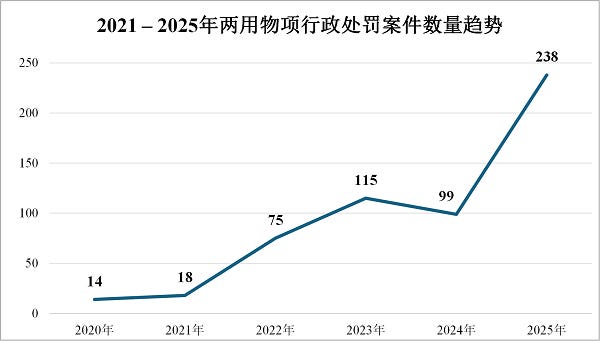
The increase could have other causes. China applied controls to many more items in 2025, expanding the universe of potential violators, including those acting out of simple ignorance. There might also be a learning-curve effect, with China getting better at enforcing controls.
However, I think the increased number represents a genuine effort to build interagency capacity. The Han Kun review describes the establishment of a “data-sharing channel” between Customs, Commerce, and the Ministry of Public Security. At the follow-up meeting in July, the Mechanism instructed the interagency to “study and establish a joint law enforcement coordination center for the export control of dual-use items”, possibly similar to the Commerce-Intelligence Community joint effort proposed in last year’s American AI Action Plan.
Conclusion
China’s export control system is developing into a force to be reckoned with. China is extremely quick to respond to US rules, is working to build licensing capacity (including by deploying detailees to BISIEC), and has found meaningful success with a unique, interagency-focused approach to export control enforcement. As the US and China continue to renegotiate their fraught economic and security relationship, it’s critical to understand China’s export control system, both to calibrate the US’s understanding of China’s true leverage and to draw lessons for the US’s own efforts.
Mandarin: 产业安全与进出口管制局, sometimes shortened to 安全与管制局 (Security and Control Bureau).
Mandarin: 商务部 (MOFCOM).
Specifically, Article 9.
As of December 2025, according to OPM FedScope Employment Data.
As of December 2025; OPM FedScope Employment Data cross-referenced with USAJobs postings to understand employment in specific job series.
Assuming three employees per licensing division (3 × 3 = 9), and that the vast majority of the detailees were assigned to licensing. I think it’s reasonable to assume most of the detailees were assigned to licensing because (1) the Secretary General of the European Chamber of Commerce in China was quoted in Reuters as appreciating that “MOFCOM has increased its resources to address demand” after meeting with them in June 2025, and he presumably was praising increased licensing capacity to European automakers, NOT increased enforcement capacity; and (2) I think MOFCOM outsources enforcement a lot more heavily than BIS does, as I elaborate on later in the piece.
OPM FedScope Employment Data cross-referenced with USAJobs postings to understand employment in specific job series.
As far as I can tell, the attrition in 2025 mostly canceled out people who had been hired in the interim.
Assuming companies began applying after the April expansion of controls, not the February expansion.
UN Comtrade data for 2024 for HS code 8505.11 (technically includes all magnets, but rare earth-based magnets dominate Chinese exports under the code).
As of December 2025, according to OPM FedScope Employment Data.
As of December 2025, according to OPM FedScope Employment Data.
Assuming three employees per enforcement division (3 × 3 = 9).
The reason the number of enforcement employees (136) is lower than the number of agent budget slots (150) is that sometimes people quit BIS (as many did in 2025), and it takes BIS a while to replace them.
Mandarin: 国家出口管制工作协调机制.
